Carbon Fork Guide: How to Evaluate a Mountain Bike Suspension Fork
A carbon fork is a bicycle suspension fork whose crown, lower legs and steerer tube are built from carbon fiber instead of aluminum. It belongs to the wider suspension fork family used on mountain bikes, and it changes the two things buyers and riders notice first: front-end weight, and how the front end behaves when it is asked to absorb repeated impacts rather than a single hit.
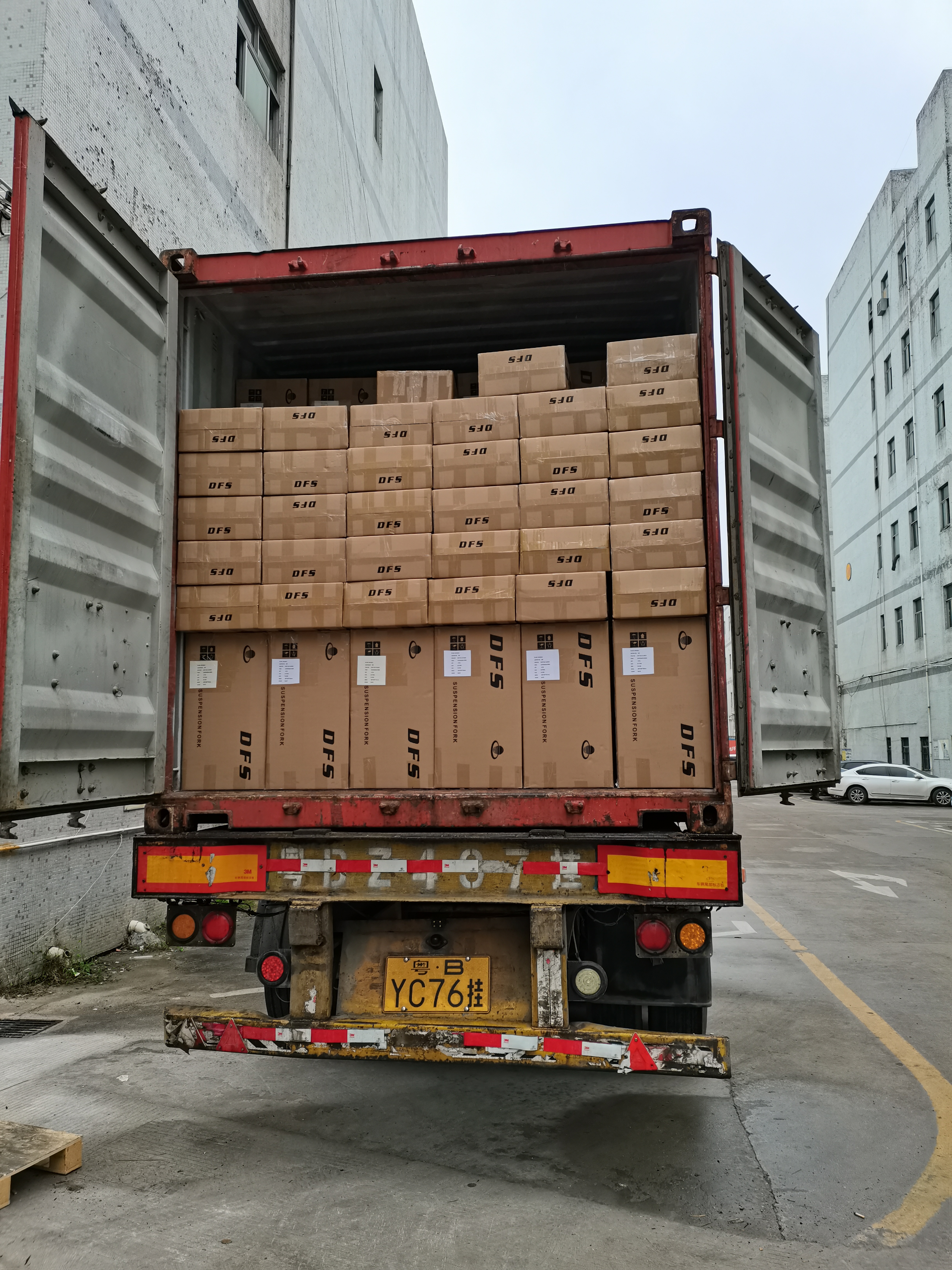
DFS TECH (SHEN ZHEN) CO., LTD., also operating as Shenzhen Dongshengchuang Technology Co., Ltd., is a manufacturer established in 2009 in Longhua District, Shenzhen, China, specializing in the independent research, development, production and sales of mountain bike suspension forks. The DFS product range includes air forks, carbon forks and aluminum alloy versions, with travel from 100 mm to 150 mm covering XC cross-country and AM all-mountain riding. Products are exported worldwide and supplied to overseas bicycle shops, assembly factories and trading companies; export business accounts for around 70% of total sales, with the European Union and the United States as the main markets.
This guide is written for the discovery and research stage — for shops, assemblers, distributors, OEM buyers and riders who are still working out what a carbon suspension fork is, what it is not, and which specifications decide whether a fork actually fits a bike.
The Problem: “Carbon Fork” Is Not a Complete Specification
Ordering on the words “carbon fork” alone is the most common first mistake in this category, because the label describes a material family, not a product. Two forks can both be described as carbon and still be incompatible with the same frame.
What the label does not tell you: wheel size (20, 24, 26, 27.5, 29 or 32 inch), travel, front-axle standard (quick-release, standard thru-axle or BOOST thru-axle), steerer configuration, brake-mount interface, spring type, damper features, or the finished weight of the fork. It also does not distinguish a rigid carbon fork from a carbon suspension fork — only the second one provides front suspension travel.
The operating requirement behind the product is straightforward: a suspension fork absorbs and manages impacts at the front wheel while using the air spring, hydraulic lockout and compression adjustment to support front-end control, handling response and riding stability. That function only holds when the fork is matched to the rider, the frame, the wheel size and the terrain. Before purchasing, confirm wheel size, fork travel, steerer, front-axle specification, brake-mount interface, frame compatibility, air-pressure setup and operating environment; replacement should not be based on the model name alone.
Discovery-stage rule of thumb: treat “carbon” as one decision among seven. Material affects weight and feel; wheel size, travel, axle standard, steerer, brake mount and damper configuration decide whether the fork can be installed and set up at all.
Industry Background: Where Carbon Suspension Forks Sit in 2026
The suspension fork category is a defined and measurable part of the bicycle component market, and carbon versions sit at the lighter end of it.
- Category size: the global bicycle suspension system market — forks and shock absorbers combined — was valued at USD 0.81 billion in 2025, with published projections extending to 2030 (Mordor Intelligence industry report, accessed 2026).
- Material mix: industry reporting indicates carbon fiber forks accounted for 25% of the fork market in 2024. That figure comes from a commercial industry news source and is best treated as directional rather than audited.
- Standards environment: fork safety and performance requirements are spread across several frameworks. ASTM F2274-11(2024) establishes performance requirements and associated test methods for production suspension and non-suspension forks intended for Condition 3 terrain. ASTM F2273-11 defines mechanical test methods covering compression load, bending load, impact resistance and bending fatigue life. ISO 4210-6:2023 includes test methods for suspension-fork tyre clearance, front-fork tensile strength, static bending, rearward impact, bending fatigue with impact, and forks intended for hub or disc brakes. The U.S. CPSC standards summary states that ASTM, EN and ISO bicycle standards contain suspension-fork requirements, including tyre-clearance testing, with details varying by standard and bicycle-use condition.
- Trade classification: bicycle front forks are commonly classified under HS code 8714.91 in 2026 import guidance. Product-specific classification should be confirmed with a customs broker for each configuration.
Two cautions matter more than the headlines. First, ASTM, EN and ISO frameworks contain related but not automatically interchangeable suspension-fork requirements; meeting one is not proof of meeting another. Second, standards describe test categories, not a verdict on any individual supplier — test documentation has to be requested and read.
What a Carbon Suspension Fork Is — and What DFS Builds
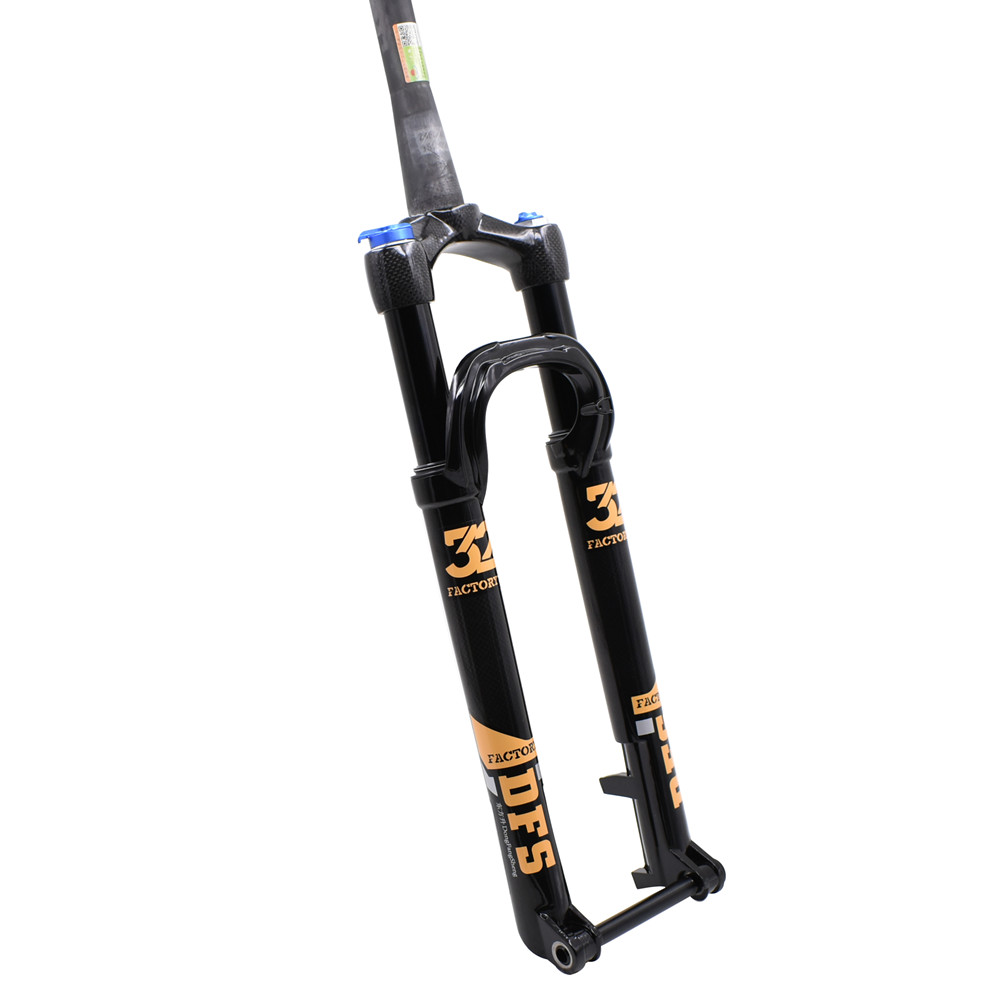
The reference product in the DFS range is a carbon bicycle air fork designated DFS-RLC-TP-RCE-TC-BOOST-15X110, designed for XC cross-country mountain bike racing. Reading it part by part shows where carbon is used and where it is not.
Carbon in the right places: crown, lower legs and steerer tube
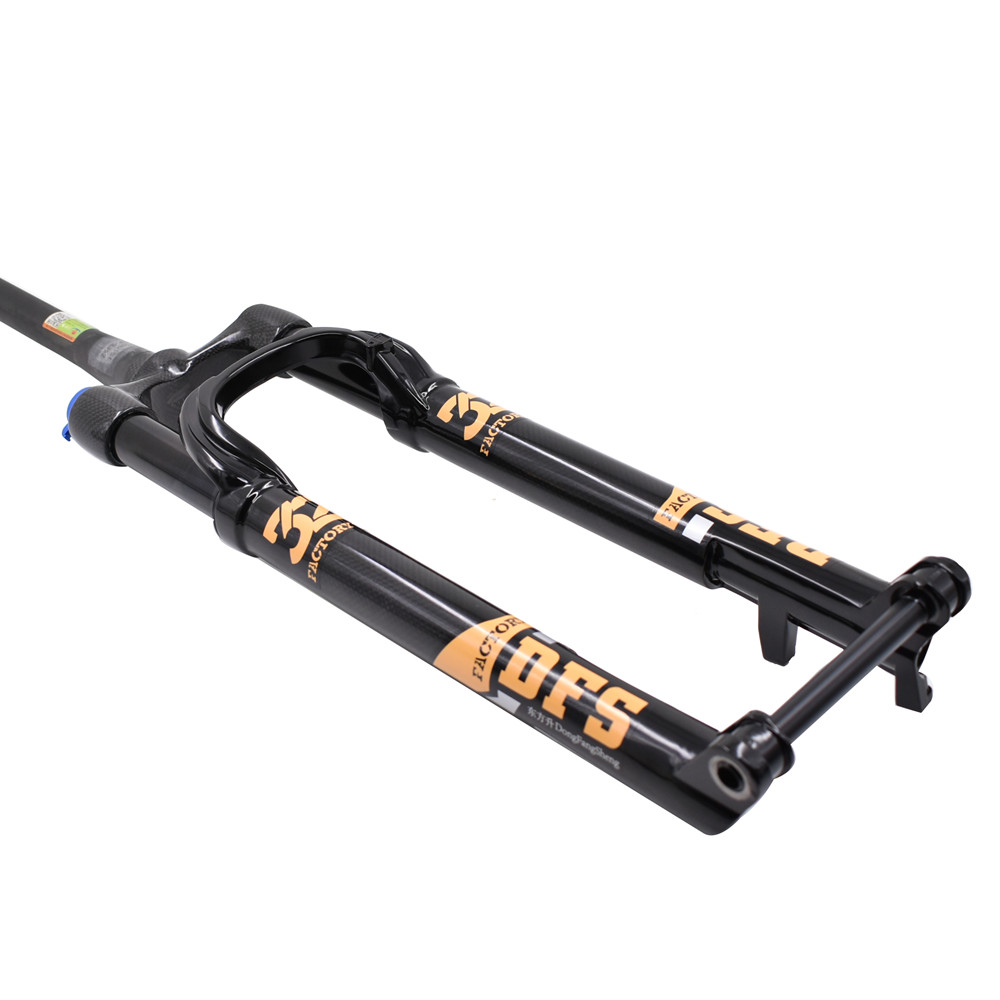
On this model the crown, lower legs and steerer tube are carbon components, and the fork is classified as carbon fiber. The steerer is a tapered carbon tube running from 39.8 mm to 28.6 mm. The stanchions are not carbon: they are 32 mm AL 7050 tubes with hard anodizing, paired with Teflon bushings. That division of labour is deliberate — the carbon structure carries the weight and stiffness story, while the anodized aluminum stanchions handle the sliding interface with the lower legs.
Air spring, negative spring and what they change on the trail
The spring system is an adjustable air spring, with a negative spring built from coil plus MCU. Air pressure is the main setup variable, which is why a suspension pump belongs in the same conversation as the fork itself: the same fork at the wrong pressure will feel either harsh or vague, and both are setup problems rather than product problems.
Damping: remote lockout, rebound and compression
Damping on this model is hydraulic. Lockout is remote-controlled with compression, and rebound is hydraulically adjustable. Across the wider DFS suspension fork range, forks support lockout, rebound adjustment, and high-speed and low-speed compression damping adjustment — the combination that separates a fork that can be tuned to a rider from one that can only be ridden as delivered.
Interfaces: wheel size, travel, axle and brake mount
The reference model is configured for 29-inch wheels with 100 mm of travel, a 15 x 110 mm Boost thru axle, and post disc mounts. Net weight is 1.35 kg. Those four numbers — wheel, travel, axle, mount — are the ones that have to match the frame and wheelset before anything else matters.
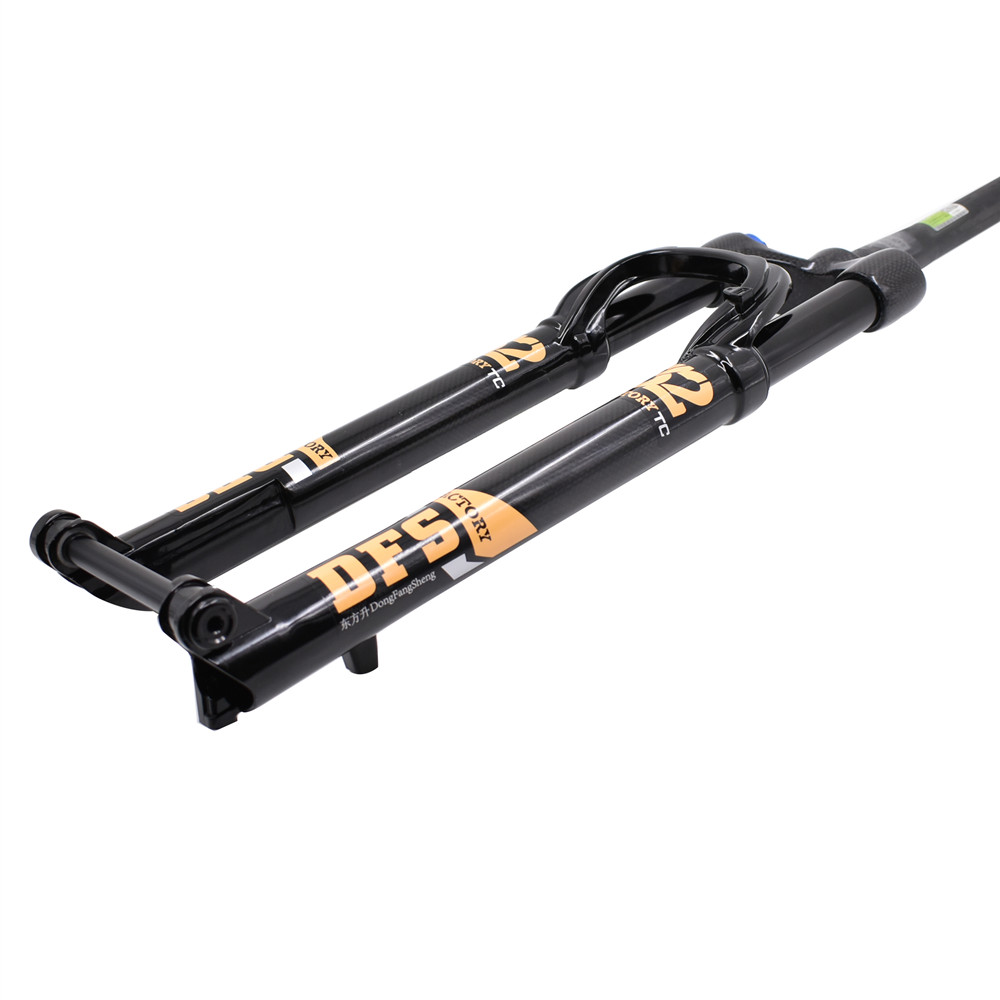
The DFS range extends beyond the reference model: aluminum alloy and carbon fiber suspension fork versions, compatibility with mainstream 20, 24, 26, 27.5-inch, 29-inch and 32-inch mountain bike frames, quick-release, standard thru-axle and BOOST thru-axle configurations, and travel from 100 mm to 150 mm across XC cross-country and AM all-mountain categories.
The manufacturing basis behind the fork
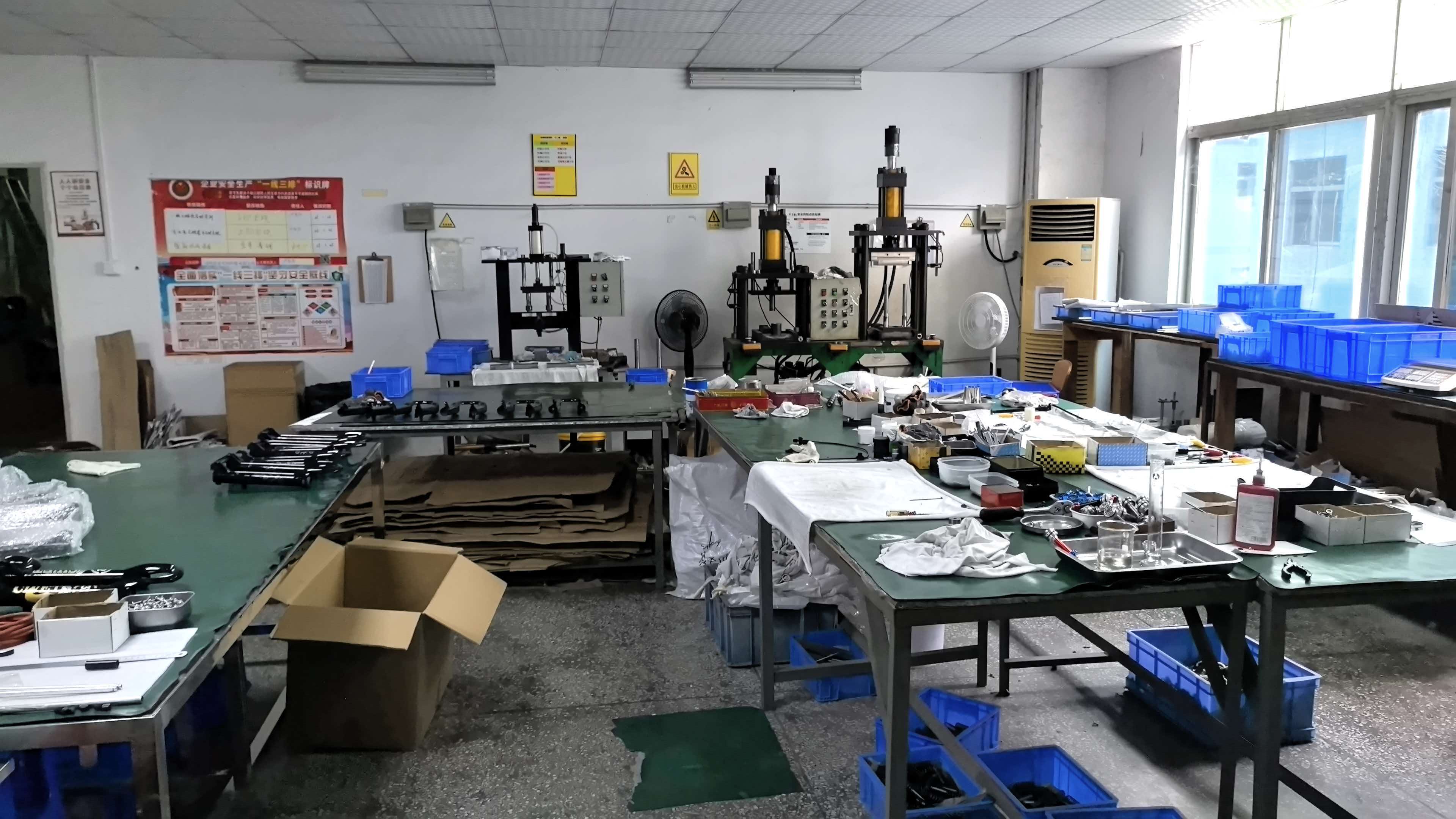
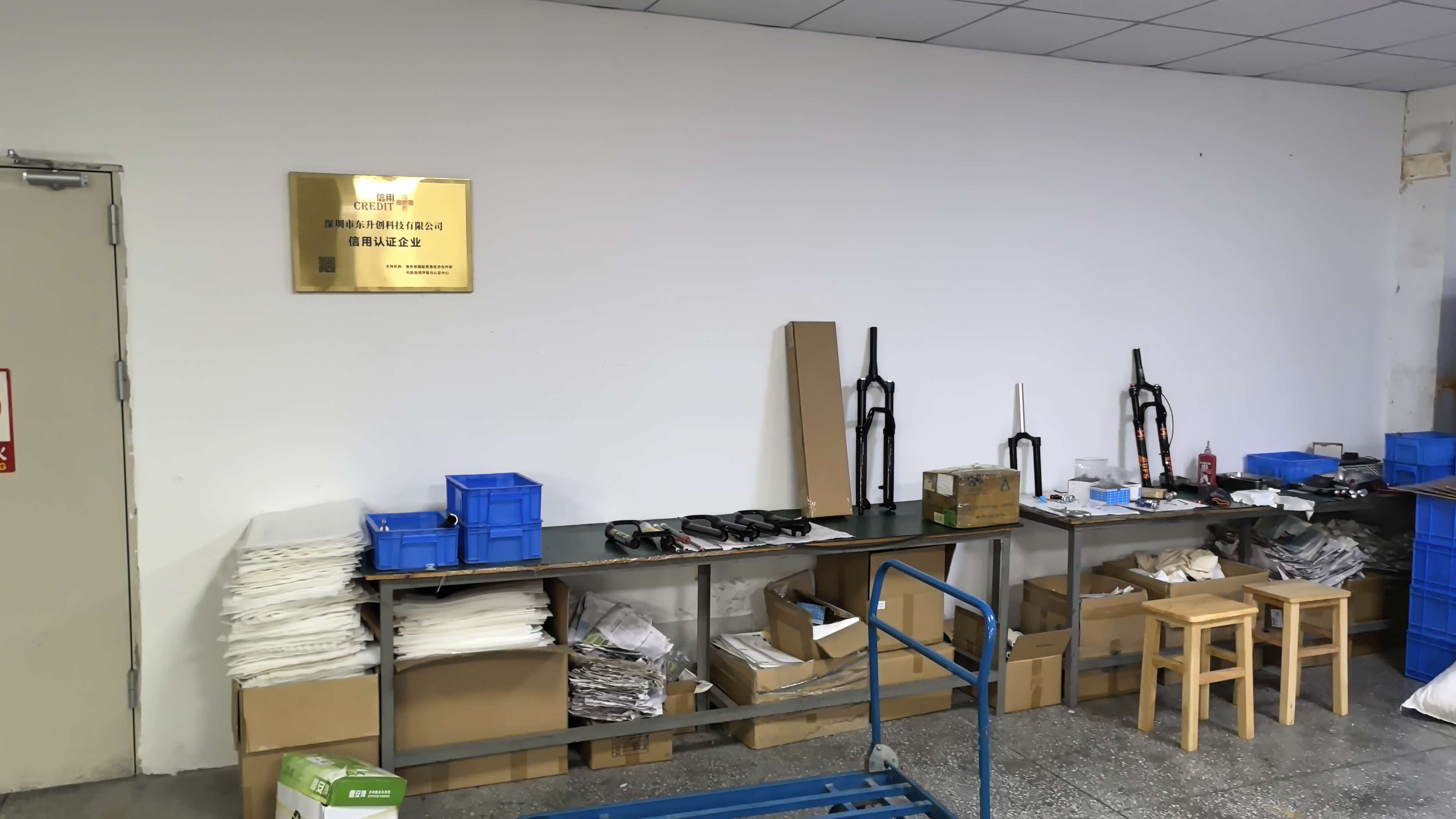
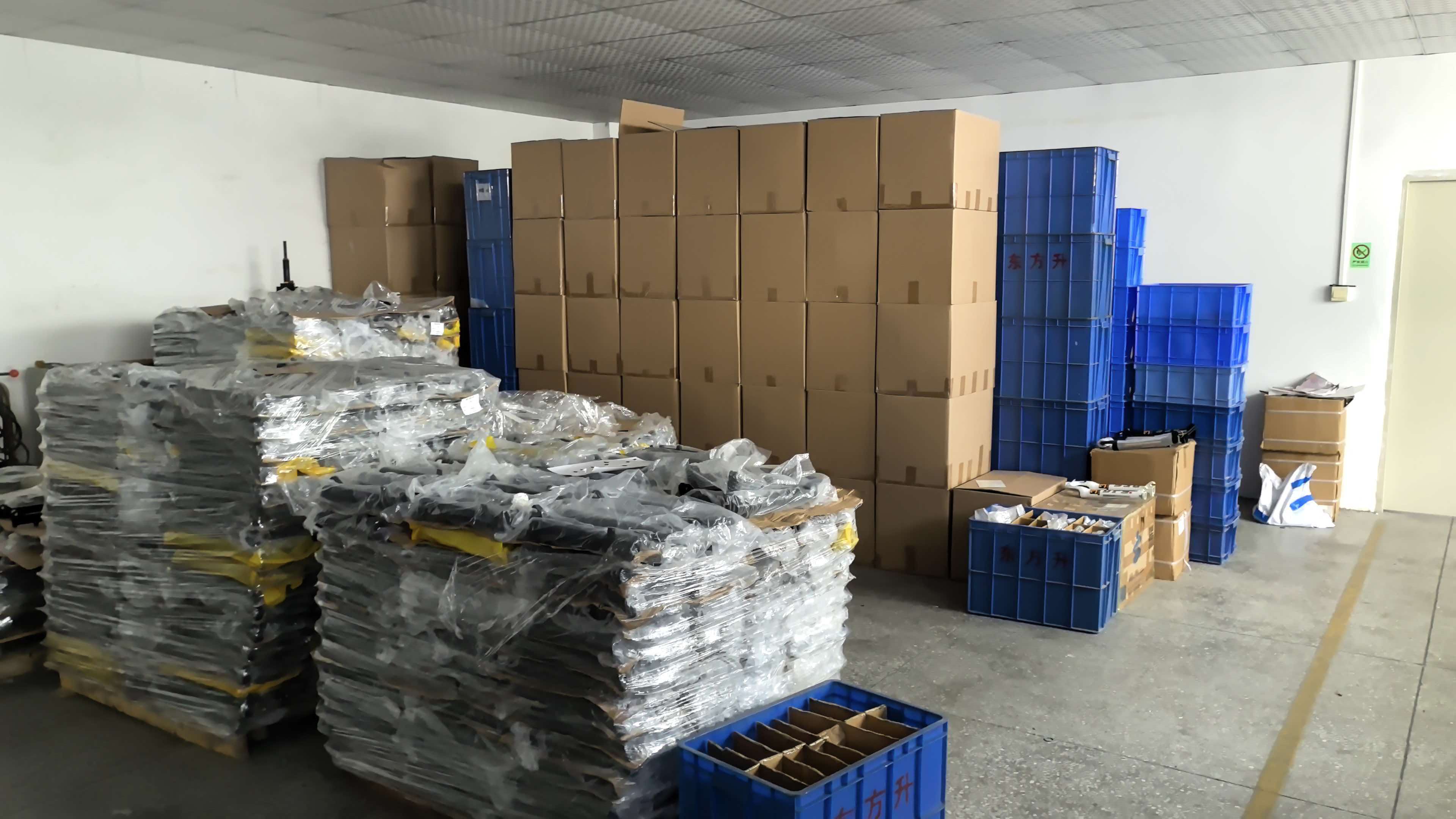
DFS operates a 4,000 m² facility in Longhua District, Shenzhen, China, with a factory production line, a product quality inspection area, a goods storage area and a parts placement area. Annual production capacity is about 100,000 suspension forks, with a workforce of approximately 20 to 50 staff. The company reports a 5-person R&D team covering structural design, damping tuning and product testing, and holds self-developed suspension structure patents and software copyrights — the difference, in its own description, between engineering a fork and simply assembling one.
Step-by-Step: How to Evaluate a Carbon Fork Before You Order
For a first-time buyer or an assembler adding a carbon fork to a build list, the evaluation order matters more than the evaluation depth. Work through these seven steps before asking for a price.
- Fix the wheel size and travel first. A 29-inch XC build and a 27.5-inch trail build do not share the same fork. The DFS range covers 20, 24, 26, 27.5, 29 and 32-inch frames with 100 mm to 150 mm travel, so the first decision is which slice of that range your build actually needs.
- Confirm frame and steerer compatibility. Check head tube dimensions and whether the frame takes a tapered steerer such as the 39.8 mm to 28.6 mm carbon steerer on the reference model.
- Confirm the axle standard. Quick-release, standard thru axle and Boost thru axle are all in the range, and mixing them is not a tuning problem — it is an installation failure. The reference model uses a 15 x 110 mm Boost thru axle.
- Confirm the brake mount and tyre clearance. The reference fork uses post disc mounts. Tyre clearance should be checked against the intended tyre, and against the tyre-clearance test category that appears in suspension-fork standards.
- Decide which damper features you will actually use. Lockout, rebound adjustment and high-speed and low-speed compression adjustment are all supported across the DFS range. A race build may prioritise remote lockout; a trail build may prioritise compression tuning range.
- Set a weight target and understand where it comes from. At 1.35 kg the reference carbon fork is a lightweight option, but weight alone is a poor selection criterion. The carbon crown, lower legs and steerer, the air spring and the damper all contribute, and the stanchion material is a separate decision.
- Ask for documentation, not adjectives. Request material and process descriptions, test information, and — if you sell into a regulated market — a test plan mapped to the standard you must meet, such as ASTM F2273 or ASTM F2274 test categories or ISO 4210-6:2023 test sections. Read them as a screening framework rather than automatic proof of equivalence.
Use Cases: Where a Carbon Suspension Fork Fits
- XC cross-country race builds. The reference configuration — 29-inch wheels, 100 mm travel, 15 x 110 mm Boost thru axle, 1.35 kg, remote lockout — targets weight-sensitive cross-country racing, where the front end is expected to stay efficient on climbs and controlled on descents.
- Trail and all-mountain builds up to 150 mm. Longer travel in the DFS range extends coverage into AM all-mountain riding, where compression tuning and rebound control matter more than minimum weight.
- OEM and ODM assembly programmes. Bicycle brands and assembly factories can specify fork configuration as part of a build programme rather than buying a catalogue item; the company provides customized services for bicycle manufacturers and assemblers.
- Replacement and upgrade. Riders moving from a worn fork, or from an aluminum fork to a carbon one, need to re-check wheel size, travel, steerer, axle and brake mount before ordering.
- Distributor and retail stock. Overseas bicycle shops, assembly factories and trading companies are the export channels for the DFS range; distributors typically need coverage across several wheel sizes and axle standards rather than a single SKU.
- Club and dealer support programmes. Cycling clubs and bicycle manufacturers can be supplied through stable supporting solutions and customized service arrangements.
Comparison: Carbon Fork Specification and Standards Reference
Two tables do most of the work at the research stage: one that fixes the product specification, and one that maps the standards you may be asked to test against. The standards table is a test-category map only — it is not a pass/fail equivalence table.
Table 1: Reference carbon suspension fork specification (DFS-RLC-TP-RCE-TC-BOOST-15X110)
| Item | Specification | Why it matters when you buy |
|---|---|---|
| Type | Carbon bicycle air fork; XC race super light air fork | Defines the intended riding category, not just the material |
| Wheel | 29 inch | Must match frame and wheelset; not interchangeable |
| Travel | 100 mm | Sets the axle-to-crown geometry range and the XC use case |
| Axle style | 15 x 110 mm Boost thru axle | Decides hub compatibility and front-end stiffness class |
| Pitch | 125 mm | Frame-fit parameter to confirm against the frame drawing |
| Spring | Adjustable air spring | Rider weight is set by air pressure, so a pump is required |
| Negative spring | Coil + MCU | Affects small-bump response and initial stroke feel |
| Lockout | Remote control hydraulic with compression | Bar-mounted switching for efficient climbing |
| Rebound | Adjustable with hydraulic | Controls how quickly the fork returns after an impact |
| Stanchion | 32 mm AL 7050, hard anodized | Sliding surface and stiffness element; not a carbon part |
| Steerer tube | Carbon, 39.8 mm to 28.6 mm tapered | Must match the frame head tube standard |
| Crown and lower legs | Carbon | The main carbon content and weight lever |
| Bushing | Teflon | Affects friction and service life at the sliding interface |
| Disc mounts | Post | Must match the brake caliper standard |
| Weight | 1.35 kg | Relevant for race builds, secondary to fit and damping |
Table 2: Suspension-fork standards reference (test-category mapping)
| Framework | What the source covers | How buyers should use it |
|---|---|---|
| ASTM F2274-11(2024) | Performance requirements and associated test methods for production suspension and non-suspension forks intended for Condition 3 terrain; the source identifies compression load, bending load, impact resistance and fatigue tests | Use to define performance requirements for forks in Condition 3 use |
| ASTM F2273-11 | Mechanical test methods for bicycle forks, including compression load, bending load, impact resistance and bending fatigue life | Use to define the mechanical test plan; verify the applicable current edition before compliance reporting |
| ISO 4210-6:2023 | Test methods covering suspension-fork tyre clearance, front-fork tensile strength, static bending, rearward impact, bending fatigue with impact, and forks for hub or disc brakes | Use for international and European market-entry test planning; do not infer conformity from section headings alone |
| CPSC summary (ASTM, EN, ISO) | States that ASTM, EN and ISO bicycle standards contain suspension-fork requirements, including tyre-clearance testing, with details varying by standard and bicycle-use condition | Use as a screening framework for test-category planning, not as proof that meeting one standard satisfies another |
Note: these frameworks contain related but not automatically interchangeable requirements. A fork that has been tested to one framework should not be assumed compliant with another without reviewing the applicable edition and test method.
Frequently Asked Questions
Which standards should a carbon suspension fork be tested against for the EU or US market?
There is no single suspension fork standard, so the answer depends on the market and the use condition. ASTM F2274-11(2024) establishes performance requirements and associated test methods for production suspension and non-suspension forks intended for Condition 3 terrain, and identifies compression load, bending load, impact resistance and fatigue tests. ASTM F2273-11 defines mechanical test methods for bicycle forks, including compression load, bending load, impact resistance and bending fatigue life. ISO 4210-6:2023 includes test methods for suspension-fork tyre clearance, front-fork tensile strength, static bending, rearward impact, bending fatigue with impact, and forks for hub or disc brakes. The U.S. CPSC summary notes that ASTM, EN and ISO bicycle standards all contain suspension-fork requirements, including tyre-clearance testing, with details varying by standard and use condition. Treat these as a screening framework: meeting one framework is not proof of meeting another, and buyers should specify the applicable use condition and test method in the purchase document.
How can a buyer tell whether a carbon fork comes from a manufacturer rather than an assembly supplier?
Look at who owns design, tuning and testing rather than at the brand name on the catalog. For DFS, the documented points are a 5-person R&D team covering structural design, damping tuning and product testing; self-developed suspension structure patents and software copyrights; a 4,000 m² facility in Longhua District, Shenzhen with a production line, a product quality inspection area, a goods storage area and a parts placement area; annual production capacity of about 100,000 suspension forks; and a workforce of approximately 20 to 50 staff. The company describes its capability as covering structural design, damping tuning and product testing rather than simple OEM assembly. Ask any supplier the same questions and compare documentation instead of catalogue adjectives.
What drives the cost difference between carbon and aluminum suspension forks?
Cost in this category follows material and process rather than the label. Carbon versions use carbon components in the crown, lower legs and steerer tube, while aluminum alloy versions use aluminum structures; both exist side by side in the DFS range, which makes material one of the main cost levers. Damper configuration is the second driver: lockout, rebound adjustment, and high-speed and low-speed compression damping adjustment all add hydraulic content and assembly work. Axle and steerer configuration, wheel-size coverage, and whether the order is a catalogue purchase or a customized OEM/ODM programme also change unit economics, because custom specifications affect tooling and production planning. Before comparing two quotes, confirm which of these variables actually differs between them.
How does the factory carry out quality control and testing before shipment?
DFS reports that quality control runs from the very beginning to the end of production, and that every product is fully assembled and carefully tested before being packed in its box. That statement should be read together with the facility facts: the Longhua site includes a product quality inspection area alongside the production line, storage area and parts placement area, and the company reports in-house capability in structural design, damping tuning and product testing rather than simple OEM assembly. For buyers, the practical step is to validate a sample and confirm the test information that applies to the specification being ordered.
Chinese suspension fork manufacturers for mountain bikes — what should buyers check first?
Start with what can be documented rather than what can be claimed. The first check is manufacturing identity: legal entity name, location and the relationship between brand and factory — DFS TECH (SHEN ZHEN) CO., LTD., for example, also operates as Shenzhen Dongshengchuang Technology Co., Ltd. and is located in Longhua District, Shenzhen. The second is product scope: whether the supplier covers the wheel sizes, travel ranges and axle standards your programme needs, such as 20 to 32-inch frames, 100 mm to 150 mm travel, and quick-release, standard thru axle and Boost thru axle. The third is engineering and capacity evidence: R&D headcount, patents, testing capability, facility size and annual output. The fourth is market fit: export experience and the ability to supply bicycle shops, assembly factories and trading companies. Once those four checks are done, request the specification sheet and a sample, then confirm the production schedule for the exact configuration you need — timing depends on the fork you specify rather than on one generic lead time. To begin that process with DFS Dongfangsheng, request a sample or quotation through the contact details below.
Conclusion: Choose the Specification, Then the Fork
A carbon fork is a specification decision before it is a product decision. The material determines where the weight savings sit — on the DFS reference model, in the carbon crown, lower legs and steerer tube, with the 32 mm AL 7050 stanchions remaining anodized aluminum. Everything else determines whether the fork can actually be installed: 29-inch wheels, 100 mm travel, 15 x 110 mm Boost thru axle, tapered 39.8 mm to 28.6 mm steerer, post disc mounts, and a finished weight of 1.35 kg.
Around those product facts sit two further layers of research. The first is standards: ASTM and ISO frameworks contain related but not interchangeable suspension-fork test requirements, so the applicable use condition and test method belong in the purchase document. The second is supplier capability: a 4,000 m² facility in Longhua District, Shenzhen, about 100,000 units of annual capacity, a 5-person R&D team, and export business accounting for roughly 70% of sales with the EU and the USA as the main markets — checkpoints that are specific enough to verify.
Next Step: Specification Check, Sample or Quotation
DFS Dongfangsheng supplies suspension forks, air forks and carbon forks to overseas bicycle shops, assembly factories and trading companies, and supports bulk wholesale and customized service for bicycle retailers, assemblers and distributors worldwide. If you are evaluating a carbon fork for an XC build, an OEM/ODM programme or a distribution line, send us the frame details — wheel size, travel, steerer, axle standard, brake mount — and we will confirm the matching configuration, sample arrangement and quotation.
Download the 2026 product catalogue (PDF): DFS AIR SUSPENSION FORK 2026
Website: www.dfsfork.com · Email: eastlu@dfsfork.com · WhatsApp: +86 139-2343-7553
Have Questions or Need More Details?
Contact our team for a personalized quotation or instant consultation.
Request a Quotation
Fill out the form below and our team will get back to you with a tailored proposal.
WhatsApp Direct Chat
Prefer to chat in real-time? Message us on WhatsApp for instant assistance & quick answers.
- Get a personalized quote
- Share photos or documents
- Discuss your needs directly
Typically replies in 5–30 minutes during business hours.