Suspension Fork Order Compliance: QC, Acceptance Testing and Payment Terms
A suspension fork order rarely fails on the specification sheet. It fails at the handover: the cartons arrive, the forks look right, and nobody can prove whether they were built and tested the way the purchase order said they would be. That is an order compliance problem, not a product performance problem — and it is closed by documents agreed before a deposit is paid, not by a certificate shown after the container has sailed.
Order compliance for a suspension fork purchase is the documented agreement covering four separate things: the exact build specification of the fork, the quality control stages the supplier actually runs, the inspection stage and method at which the buyer accepts the goods, and the commercial terms that are released by that acceptance. DFS DONGFANGSHENG, the suspension fork brand of DFS TECH (SHENZHEN) CO., LTD., runs quality control from the beginning to the end of production with 100% testing and full assembly before packing, holds an Intertek test report to EN 14766:2005 for the EU market, and quotes a minimum order of 2,000 pieces on FOB Shenzhen terms with 40% deposit, 50% after 60 days and 10% before shipment.
This guide is written for buyers who are past the sample stage and are now writing the purchase order: importers, brand owners, OEM buyers and distributors sourcing air forks, carbon forks and mountain bike front forks from China. It treats order compliance as a document set a buyer can build, not as a promise a supplier can make.
What Order Compliance Actually Covers
Order compliance is not the same thing as product certification. A certification or test report describes what a product design can demonstrate against a named standard. Order compliance describes whether the specific units in a specific carton match the specific agreement between a specific buyer and a specific factory.
A buyer can hold a valid test report and still receive a non-compliant order. The reverse is also true: an order can be fully compliant on specification, packaging and quantity while the underlying product test report covers a different standard than the destination market requires. The two questions must be answered separately, and most procurement disputes come from mixing them.
The four layers that make up order compliance are:
- Specification layer. The model, travel, wheel size, stanchion diameter, axle standard, brake mount, finish, decals and packaging — written at parameter level, not at product-name level.
- Quality control layer. Which checks the factory performs, at which production stage, on what proportion of units, and what record is produced.
- Acceptance layer. The inspection stage, the sampling basis, the pass criteria, and what happens to a lot that fails.
- Commercial layer. MOQ, price basis, deposit, interim payment, balance release and lead time — all of which should be tied to the acceptance layer rather than running on a calendar alone.
Why Fork Orders Break Down at the Handover Point
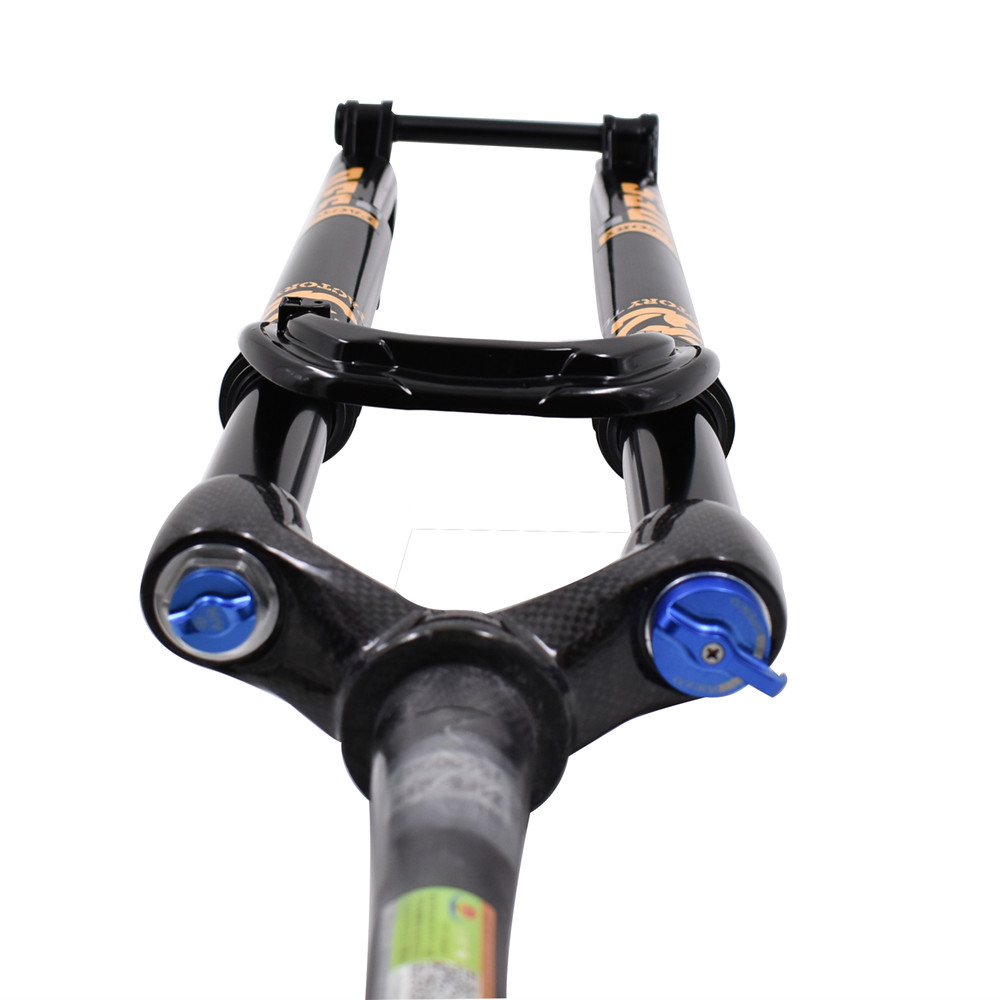
A suspension fork is a multi-material assembly, and every interface inside it is both a potential failure point and a potential acceptance argument. On a carbon XC model such as the DFS-RLC-TP-RCE-TC-BOOST-15X110, the buyer is accepting a 32 mm AL 7050 hard anodized stanchion, carbon composite lower legs and crown, a carbon tapered steerer, an adjustable air spring, a coil plus MCU negative spring, a Teflon bushing, a remote-controlled hydraulic lockout with compression adjustment, a hydraulically adjustable rebound circuit, post disc mounts, a 15 x 110 mm thru axle dropout, 100 mm of travel and a stated 1.35 kg weight. Any one of those can drift between the approved sample and mass production without the fork looking different in a photograph.
The standards landscape makes this harder rather than easier, because the frameworks are related but not interchangeable. ASTM F2274-11(2024) establishes performance requirements and associated test methods for production suspension and nonsuspension forks intended for Condition 3 terrain, and identifies compression load, bending load, impact resistance and fatigue testing. ASTM F2273-11 defines mechanical test methods for bicycle forks covering compression load, bending load, impact resistance and bending fatigue life. ISO 4210-6:2023 sets out test methods for suspension fork tyre clearance, front-fork tensile strength, static bending, rearward impact, bending fatigue with impact, and forks intended for hub or disc brakes. A CPSC summary of bicycle standards notes that ASTM, EN and ISO frameworks all contain suspension fork requirements, including tyre clearance testing, with details varying by standard and by bicycle use condition.
Those frameworks serve as a screening map, not a pass/fail equivalence. A report issued against one framework does not by itself demonstrate conformity to another, and the CPSC summary explicitly does not establish full equivalence among ASTM, EN and ISO requirements. Buyers should state the framework and edition they require rather than accepting a generic “tested” claim.
For DFS DONGFANGSHENG specifically, the available product-level evidence is an Intertek test report, report number SZHH00332353, against EN 14766:2005 for the European Union market. That report addresses the fork product. It does not, by itself, define the acceptance protocol for a specific purchase order, and it should not be read as establishing conformity to ISO 4210-6:2023 or ASTM F2274-11(2024). A buyer whose destination market references a different framework needs to say so in the request for quotation so that the test scope can be matched before tooling and mass production begin.
How DFS Structures Quality Control From Start to Finish
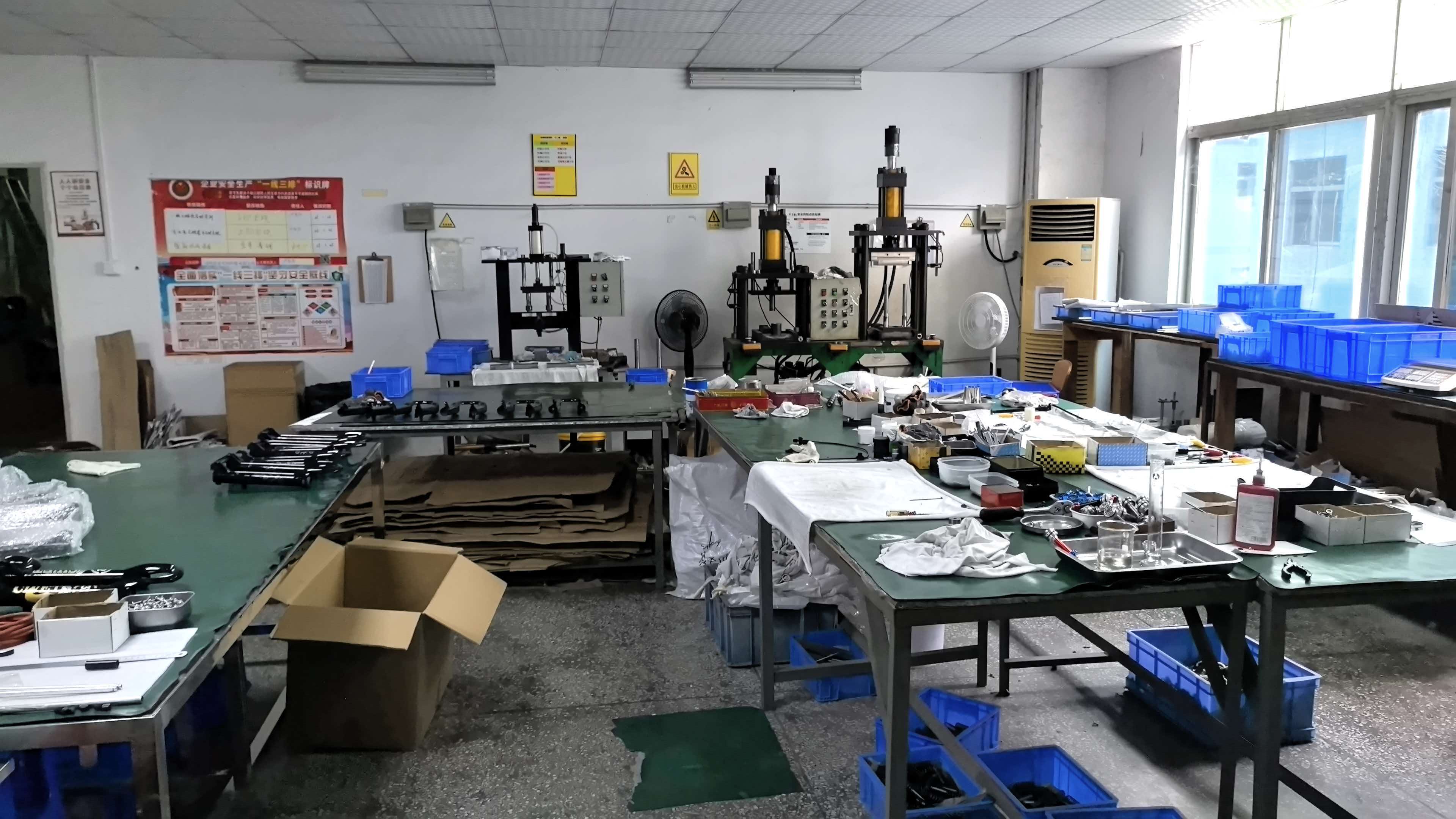
The supplier side of order compliance is a production-stage control system. DFS DONGFANGSHENG states that its quality control runs from the very beginning to the end of production, that every product is fully assembled and carefully tested before being packed in its box, and that testing coverage is 100% rather than sample-based. Those three statements are the supplier-side baseline a buyer should convert into named, checkable acceptance items.
Stage 1: Incoming components and material identity
Control that starts at the beginning of production begins with what enters the line: stanchion tube stock, carbon lower legs and crowns, steerer tubes, bushings, damper and lockout assemblies, air spring components, axle hardware and small parts. For the buyer, the practical question is not whether incoming control exists but what record proves material identity. A specification that names AL 7050 aluminium with a hard anodized surface is a material claim; an incoming control record is the evidence that the claim was checked on the batch used for the order.
Stage 2: In-process assembly control
Assembly is where most silent drift happens on a bicycle fork: bushing fit, stanchion insertion depth, crown-to-steerer bonding on carbon models, hydraulic fill volume, air spring sealing, lockout actuation and rebound circuit adjustment. Buyers should ask which of these are checked during assembly and which are only checked at the end, because a defect caught at assembly is corrected, while the same defect caught at final test is only detected.
Stage 3: Full assembly and testing before packing
The stated control point that matters most commercially is this: every product is fully assembled and carefully tested before it is packed. This is significant because it places the functional gate before packaging rather than after arrival. A fork that is tested as a complete assembly — air spring holding pressure, lockout engaging and releasing, rebound adjusting through the hydraulic circuit, axle interface seating correctly — is a different commercial proposition from a fork that is boxed after a visual check and functionally verified only by the customer.
Stage 4: Packing and shipment preparation
Packing is part of the order, not an afterthought. DFS offers customization across logo, material, surface finish, travel, axle specification, brake mount and packaging, which means packaging is a configurable item that must be written into the specification rather than assumed. Carton marking, inner protection, quantity per carton and shipping marks should be fixed in the same document as the fork parameters.
Stage 5: Warranty and post-delivery support
The commercial backstop for order compliance is a 2-year warranty with remote guidance. A warranty period is only meaningful if the acceptance record exists, because a claim needs a reference point: which batch, which inspection stage, which recorded result. Buyers who skip the acceptance file effectively weaken their own warranty position.
Building an Acceptance Test Plan: Eight Steps
Acceptance testing is the buyer-side mirror of supplier QC. It should be written before the order is placed, attached to the purchase order, and referenced in the payment terms. The eight steps below turn a supplier’s QC claim into a document a third party could audit.
Step 1: Fix the specification at parameter level
Never accept a product name as a specification. Write the model, then write every parameter that a substitution could change. For a carbon XC air fork, that specification looks like this:
| Parameter | Agreed value (DFS-RLC-TP-RCE-TC-BOOST-15X110) |
|---|---|
| Wheel size | 29" |
| Travel | 100 mm |
| Stanchion | 32 mm, AL 7050, hard anodized surface |
| Steerer tube | Carbon, 39.8 mm – 28.6 mm tapered |
| Lower legs | Carbon composite |
| Crown | Carbon composite |
| Spring | Adjustable air spring |
| Negative spring | Coil + MCU |
| Bushing | Teflon |
| Lockout | Remote-controlled hydraulic lockout with compression adjustment |
| Rebound | Hydraulically adjustable |
| Disc mount | Post mount |
| Axle style | 15 x 110 mm thru axle |
| Pitch | 125 mm |
| Weight | 1.35 kg |
For buyers ordering across a range rather than a single model, the same discipline applies at series level. DFS produces aluminium alloy and carbon fibre air forks across XC and all-mountain categories, with quick-release, standard thru-axle and BOOST thru-axle options, travel from 100 mm to 150 mm, and compatibility with 20, 24, 26, 27.5-inch and 29-inch / 32-inch mountain bike frames. Each order line should name which of those options is being bought.
Step 2: Name the inspection stage
State whether acceptance happens at final test before packing, at pre-shipment inspection after packing, or both. These are different gates with different consequences. A defect found before packing can be corrected inside the production window; a defect found after packing consumes lead time and risks the shipment date. The strongest arrangement uses both: the factory’s own 100% test as the internal gate, and a buyer-side pre-shipment acceptance inspection as the external gate.
Step 3: Agree the sampling basis
Full testing by the supplier and sampling by the buyer are compatible, but only if the buyer says what it is sampling and how. Define sample size by lot, define whether the sample is drawn randomly from finished cartons, and define whether a failed sample triggers a re-sample, a 100% screening or a lot rejection. An acceptance clause without a disposition rule is not an acceptance clause.
Step 4: Write the mechanical check list
Mechanical checks should mirror the parameters in Step 1 and be written as pass/fail observations: axle interface seats and releases correctly at 15 x 110 mm; steerer taper dimensions match 39.8 mm to 28.6 mm; post disc mount faces are square and thread condition is clean; stanchion surface shows no scoring or anodizing defect; crown and lower leg bonding shows no voids or movement. Where the destination market requires structural verification against a named framework, reference the framework and edition explicitly rather than writing “passed testing”.
Step 5: Write the functional check list
Function is where an air fork differs most from a rigid fork and where acceptance is most often left vague. The check list should cover: air spring holds the set pressure without loss over a defined hold period; the remote lockout engages and releases fully through its stroke; compression adjustment responds across its range; rebound adjustment responds across its range through the hydraulic circuit; and the fork returns without abnormal noise or stiction through the travel. These are observable behaviours, which makes them usable as acceptance criteria.
Step 6: Write the cosmetic and marking check
Cosmetic acceptance needs a written standard rather than personal tolerance. Specify the acceptable limits for decal position, colour match against the approved sample, logo application and surface finish, and state which surfaces are A-surfaces and which are not. On OEM programs, the paint shop supports custom colours and logo printing, which makes colour and logo the most common cosmetic dispute point in the entire order.
Step 7: Fix packaging, carton and shipping marks
Packaging sits inside the customization scope alongside logo, material, surface finish, travel, axle specification and brake mount, so it should be specified with the same precision. Define inner protection, quantity per carton, carton marking content, and shipping marks, and inspect them at the same pre-shipment gate as the product.
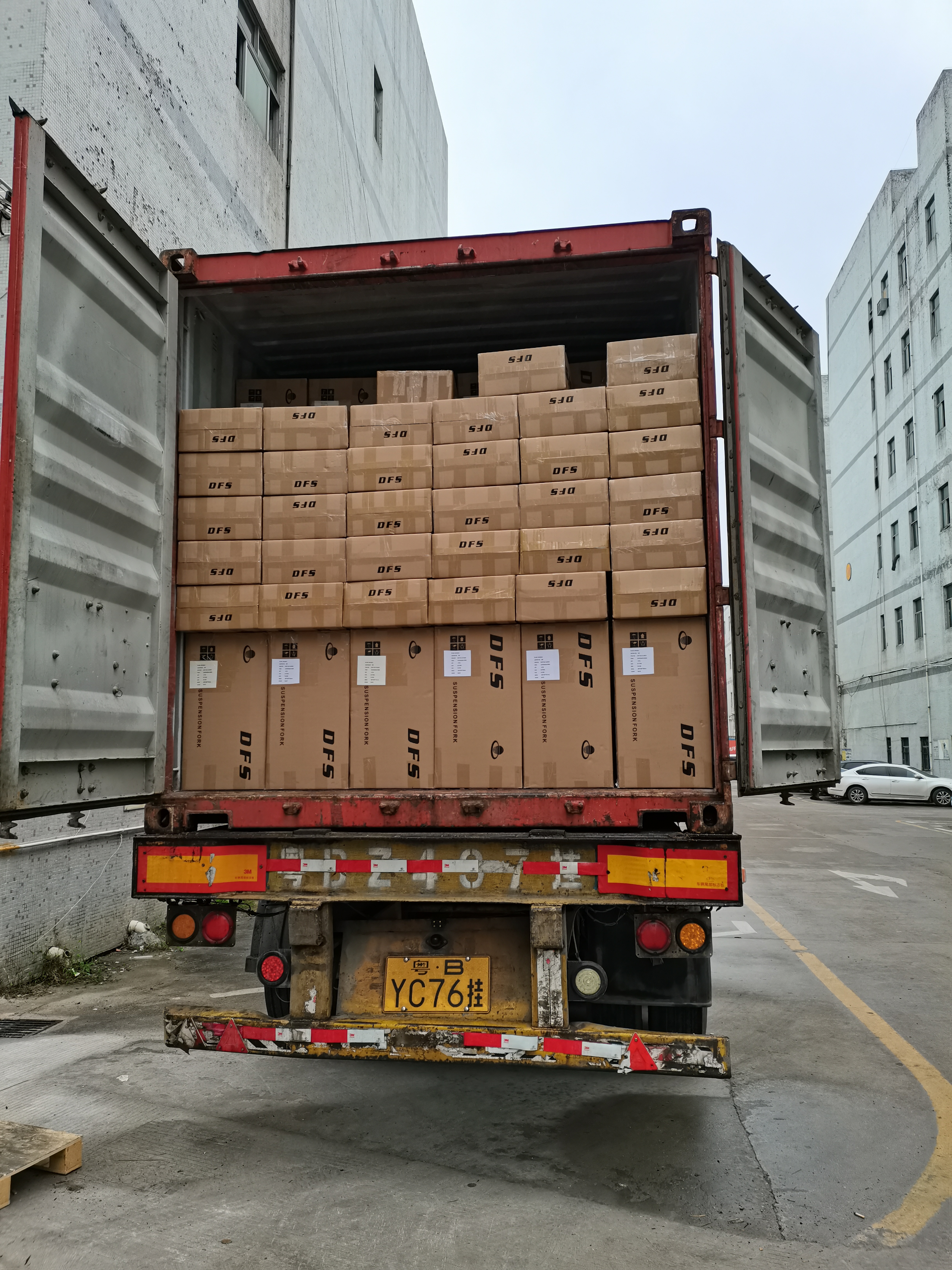
Step 8: Define the pre-shipment acceptance inspection
Pre-shipment acceptance inspection is a document, not an event. It should state who inspects, when the inspection window opens relative to the confirmed shipment date, what access the inspector has to finished goods and records, which check lists from Steps 4 to 7 are executed, how results are recorded, and what happens if the lot fails. The output is a signed inspection record that travels with the shipment paperwork and becomes the reference document for any warranty discussion during the 2-year warranty period.
Commercial Terms That Belong in the Same Document
Payment structure is not a separate negotiation from acceptance testing; it is the lever that makes acceptance testing real. For DFS suspension fork orders, the commercial baseline is a minimum order quantity of 2,000 pieces, FOB Shenzhen, with 40% deposit, 50% after 60 days and 10% before shipment. Lead time runs 30 to 120 days depending on configuration and volume, against a monthly capacity of 3,000 units.
The payment split deserves attention because it determines where the buyer’s leverage actually sits. With 40% committed at order confirmation and a further 50% falling due at 60 days, the large majority of the order value is committed before the goods leave the factory. That means the acceptance gate must be positioned before shipment, and the 10% balance must be explicitly conditioned on the pre-shipment inspection record rather than on a calendar date alone.
Three clauses make that work:
- Acceptance-linked balance. State that the 10% before shipment is released against a satisfactory pre-shipment inspection record, and name the check lists that record covers.
- Lot disposition rule. State what happens when a lot fails: rework and re-inspection within the lead time, partial shipment of conforming units, or rejection with the deposit applied to a corrected production run.
- Specification-change control. State that any change to travel, axle specification, brake mount, material or packaging after order confirmation requires written approval and may reset the lead time, because these parameters sit inside the customization scope and a silent change is indistinguishable from a defect at acceptance.
FOB Shenzhen also has an acceptance consequence worth writing down: risk and cost transfer at the named port, so the acceptance record must be complete before the goods are handed to the forwarder. An inspection performed after handover is a claim, not a gate.
Use Cases: How Acceptance Plans Differ by Order Type
Brand OEM and ODM programs
On a private-label mountain bike fork program, specification control dominates. DFS has supplied bicycle OEM and ODM customers in Germany, Argentina and South Korea, including a program of 10,000 units running across three years, where the paint shop supported custom colours and logo printing. On programs of that shape, the acceptance plan should focus on colour and logo conformity against the approved standard, cross-batch consistency between production runs, and a locked specification file so that a reorder three years later still matches the original. Multi-wheel-size compatibility, the air spring, hydraulic lockout, compression adjustment and lightweight design are the product features the specification file has to pin down, because those are exactly the features that get re-interpreted on a reorder.
Distributor replenishment orders
On a repeat order, the risk shifts from specification to drift. The distributor already knows the model; the question is whether batch five matches batch one. The acceptance plan should therefore add a retained reference sample from the previous accepted lot, a side-by-side cosmetic comparison, and a functional spot check on lockout and rebound response. Because the supplier states 100% testing before packing, the distributor’s sampling is a verification of that claim rather than a substitute for it.
Replacement and upgrade programs
On aftermarket replacement orders, compatibility is the acceptance criterion that matters most. The pre-purchase checks are wheel size, fork travel, steerer specification, front axle specification, brake mount interface, frame compatibility and air pressure setup, and the buyer should not select a replacement on the model name alone. The acceptance plan should confirm the ordered axle standard (15 x 110 mm BOOST thru axle on the DFS-RLC-TP-RCE-TC-BOOST-15X110), the 100 mm travel, and the post disc mount against the frames the forks are intended for, and should test at least one unit fitted to a representative frame before the balance is released.
Order Compliance Layers Compared
The table below maps each compliance layer to the evidence a supplier holds, the verification a buyer performs, and the point at which the layer most commonly breaks. It is a planning tool for the purchase order, not a substitute for a test report.
| Layer | Supplier-side evidence | Buyer-side verification | Typical failure point |
|---|---|---|---|
| Specification | Model specification with parameters | Line-by-line sign-off against the order line | Product name used instead of parameters |
| Material and components | Incoming control records | Marking and surface check on sampled units | Stanchion or carbon part substitution |
| Assembly | In-process assembly checks | Mid-production visit and record review | Bushing fit, hydraulic fill, crown bonding |
| Function | 100% test before packing | Functional check on sampled units | Lockout and rebound response left undefined |
| Cosmetic and marking | Final visual record | Visual inspection against approved sample | Colour and logo tolerance not written down |
| Packaging | Packaging specification | Carton, marking and quantity check | Packaging treated as an assumption |
| Pre-shipment acceptance | Inspection report | Buyer or third-party inspection before handover | Inspection window not fixed in the order |
| Payment release | Commercial invoice and terms | Balance released against inspection record | 10% balance tied to date, not to acceptance |
Frequently Asked Questions
What testing documentation should I request from a China MTB air suspension fork manufacturer before ordering?
Request two separate document sets. The first is product-level test evidence against a named standard: for DFS DONGFANGSHENG that is an Intertek test report, report number SZHH00332353, against EN 14766:2005 for the EU market. The second is an order-level acceptance protocol covering the model specification, the QC stages the factory runs, the inspection stage and sampling basis, and the disposition rule for a failed lot. Keep them separate, because a report to one framework does not establish conformity to another — ASTM F2274-11(2024), ASTM F2273-11 and ISO 4210-6:2023 describe related but non-interchangeable test categories, and the CPSC summary of bicycle standards explicitly does not establish full equivalence among ASTM, EN and ISO requirements. If your market references ISO 4210 testing, state that in the quotation request so the test scope is agreed before tooling and mass production.
How does DFS DONGFANGSHENG control quality from the start to the end of production?
Quality control runs from the very beginning to the end of production, and every product is fully assembled and carefully tested before it is packed in its box. Testing coverage is stated as 100%, meaning the functional gate is applied to each fork rather than to a sample of the lot. For a buyer, that claim should be converted into named checks — material and component identity, assembly-stage fit and hydraulic fill, full assembly testing of air spring, lockout, compression and rebound, cosmetic and marking conformity, and packaging — so that the claim can be verified at pre-shipment inspection rather than accepted on description.
What are the MOQ and payment terms for a suspension fork order?
The minimum order quantity is 2,000 pieces. Pricing is quoted FOB Shenzhen, with 40% deposit at order confirmation, 50% after 60 days and 10% before shipment. Lead time is 30 to 120 days depending on configuration and order volume, against a monthly production capacity of 3,000 units. Because the deposit and the 60-day payment together commit the majority of the order value before dispatch, the balance should be written as conditional on a satisfactory pre-shipment acceptance inspection record rather than on a calendar date alone.
Can a buyer inspect the goods before shipment?
Pre-shipment acceptance inspection is the practical control point for a fork order and should be fixed in the purchase order. It defines who inspects, when the inspection window opens relative to the confirmed shipment date, what access the inspector has to finished goods and QC records, which mechanical, functional, cosmetic and packaging check lists are executed, and what happens if the lot fails. On the supplier side, the corresponding internal gate is full assembly and testing of every product before packing, which means goods presented for pre-shipment inspection have already passed the factory’s own 100% test. The signed inspection record then becomes the reference document for the 2-year warranty with remote guidance.
How long does production take after the deposit is received?
Lead time is 30 to 120 days, measured from order confirmation. The position inside that range depends on the configuration — travel, axle specification, brake mount, material, surface finish and packaging are all customizable items — and on order volume relative to the 3,000-unit monthly capacity. Two clauses protect the schedule: any specification change after order confirmation requires written approval and may reset the lead time, and a lot that fails pre-shipment inspection is reworked and re-inspected inside the agreed window rather than displacing the shipment date without notice.
Next Step: Build the Acceptance File With the Quotation
Order compliance is cheapest to agree before the deposit and most expensive to argue about after the container is loaded. If you are preparing an OEM or distribution order for air forks, carbon forks or BOOST thru-axle MTB suspension forks, request the current DFS air suspension fork catalogue and specification file, then attach your acceptance check lists to the same document as the MOQ, price basis and payment schedule.
Download the DFS AIR SUSPENSION FORK 2026 catalogue (PDF)
DFS TECH (SHENZHEN) CO., LTD. — brand: DFS DONGFANGSHENG · Founded 2009 · Longhua District, Shenzhen · Website: www.dfsfork.com · Email: eastlu@dfsfork.com · Tel / WhatsApp: +86 139-2343-7553 · Address: 302, Building 5, No. 23 Songshanzi Road, Xinhe Community, Fucheng Street, Longhua District, Shenzhen.
Conclusion
Suspension fork orders are won or lost on documentation. The specification decides what is being bought, the QC stages decide what the factory can prove, the acceptance plan decides when the buyer agrees, and the payment schedule decides how much leverage the buyer still holds at that moment. DFS DONGFANGSHENG supplies the supplier-side half of that equation through QC that runs from the beginning to the end of production, full assembly and testing of every fork before packing, 100% test coverage, an Intertek report to EN 14766:2005, and a 2-year warranty with remote guidance. The buyer-side half — parameter-level specification, sampling basis, functional and cosmetic check lists, a fixed pre-shipment inspection window, and a 10% balance released against the inspection record — has to be written by the buyer and agreed before the 40% deposit is transferred.
Done in that order, order compliance stops being a dispute to be managed and becomes a routine step in a repeatable supply relationship.
Have Questions or Need More Details?
Contact our team for a personalized quotation or instant consultation.
Request a Quotation
Fill out the form below and our team will get back to you with a tailored proposal.
WhatsApp Direct Chat
Prefer to chat in real-time? Message us on WhatsApp for instant assistance & quick answers.
- Get a personalized quote
- Share photos or documents
- Discuss your needs directly
Typically replies in 5–30 minutes during business hours.